
Key takeaways
- Calcium (Ca) and phosphorus (P) must stay in a balanced ratio; feeding “mostly meat” without structured mineral supplementation is the most common DIY failure mode.
- Puppies—especially large-breed puppies— are the least forgiving audience for guesswork; growth plates are sensitive to both deficiency and excess.
- Bone, bone meal, eggshell, and commercial balancers all contribute Ca and P differently; you cannot swap them 1:1 by weight.
- This article teaches estimation and sanity checks, not a substitute for a board-certified veterinary nutritionist when you are feeding a fully homemade diet long term.
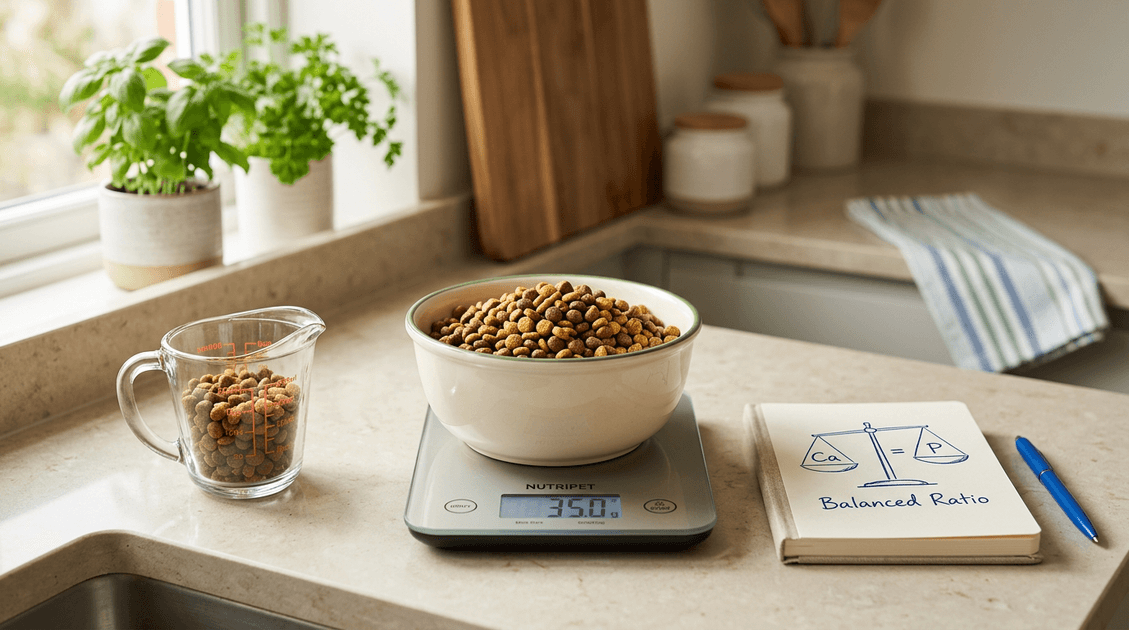
Homemade dog food is appealing: you control ingredients, transparency, and palatability. But there is a quiet reason many DIY diets underperform in the real world: two minerals—calcium and phosphorus—are easy to get wrong even when everything else looks “healthy.” The goal of this guide is not to replace your veterinarian or a veterinary nutritionist. It is to give you clear math, conservative guardrails, and a decision tree so you know when DIY math is “good enough for a conversation” and when it is not.
Why calcium and phosphorus matter together
Calcium and phosphorus are structural minerals for bone and teeth, but they also participate in nerve signaling, muscle contraction, and energy metabolism. In nutrition, the ratio of calcium to phosphorus (often written Ca:P) is often discussed because many whole-food ingredients (especially muscle meat and organ meats) are high in phosphorus relative to calcium.
If you feed lots of lean meat without enough absorbable calcium, the body may pull calcium from bone to compensate. That is not a sustainable “strategy”—it is a pathway to nutritional secondary hyperparathyroidism and poor skeletal outcomes in young dogs.
If you add too much calcium—especially in large-breed puppies—you can also create orthopedic risk. The takeaway is not fear; it is proportionality: balance matters as much as totals.
What “targets” mean (and what AAFCO is really saying)
Commercial diets in the U.S. are often formulated against AAFCO nutrient profiles and feeding trials. For homemade diets, owners sometimes try to “meet AAFCO” by eyeballing ingredients. That is where people get into trouble: meeting minimums on paper is not the same as proving long-term adequacy across micronutrients.
For practical DIY planning, many nutritionists discuss:
- Absolute calcium and phosphorus requirements by life stage (puppy vs adult; large-breed puppy considerations)
- Ca:P ratio as a secondary check, because many imbalanced diets fail the ratio first
Important: This is educational content. Your dog’s medical needs (kidney disease, malabsorption, endocrine disease) can change targets.
If you want a broader foundation on how labels and “complete and balanced” statements work, read our guide:
The “mostly meat” trap (why your recipe looks premium but fails minerals)
A common DIY pattern looks like:
- Ground meat
- A little rice or sweet potato
- Some vegetables
- “A multivitamin”
Muscle meat is rich in phosphorus and not a reliable calcium source for dogs. Liver is nutrient-dense but can skew micronutrients and vitamin A if overused. Without a deliberate calcium source and a careful mineral balance, you can create a diet that looks “fresh” to the human eye but is not robust for the dog’s skeleton.
How different calcium sources behave (conceptually)
Bone (raw meaty bone, ground bone)
Bone can supply calcium and phosphorus in a ratio that resembles bone. That can be helpful for some formulations—but it is not automatically “self-balancing” if the rest of the recipe adds large amounts of phosphorus-rich meat without modeling.
Bone also varies by animal, cut, and processing. If you are using bone as a calcium source, you must treat it as a variable ingredient, not a constant.
Bone meal / eggshell / calcium carbonate
These are common calcium additions, but they are not interchangeable in naive cup-measures. Particle size, bioavailability, and what else is in the meal changes the effective calcium contribution.
“Balancers” and premixes
Some owners use commercial nutrient mixes designed to pair with raw or cooked bases. If you go this route, you are essentially choosing formulator oversight for the hardest micronutrient layer. That is often the safest DIY route for non-experts.
A practical sanity-check workflow (without pretending precision is free)
If you are not using a formal spreadsheet validated by a nutrition professional, you can still use a disciplined workflow:
- Write down the recipe as weights, not “handfuls.”
- Identify the calcium source explicitly (bone vs supplement vs premix).
- Check whether the recipe is for a puppy or adult and whether the dog is large-breed.
- Ask the uncomfortable question: “If I remove the calcium supplement, does the recipe still look plausible?” If yes, you probably were not actually anchored to calcium math in the first place.
For calorie and energy math that pairs with portioning, these guides are useful:
- How MER and RER help you estimate true daily energy needs
- RER explained: your pet’s basic calorie needs
Large-breed puppies: the highest-stakes case
Large-breed puppies are not just “smaller dogs with bigger kibble.” Growth plate dynamics and rapid growth phases make both deficiency and excess more consequential.
If you are feeding a homemade diet to a large-breed puppy, the default stance should be:
- Assume you need professional formulation unless you are using a proven commercial premix exactly as directed and your veterinarian agrees.
When to stop reading articles and call a professional
You should involve your veterinarian or a veterinary nutritionist promptly if:
- You are feeding 100% homemade long term.
- Your dog is a puppy, pregnant/lactating, or has medical conditions.
- You are trying to combine raw bone + high organ meat + supplements without a verified formulation.
FAQ
Can I balance calcium and phosphorus “over time” like wolves?
“Balance over time” is a risky framing for puppies and for many adults unless you truly know the rolling averages. Commercial diets are balanced per meal in practice; DIY “rotation” is where mistakes hide.
Is eggshell enough calcium for my dog?
Sometimes eggshell can be part of a plan, but you need a verified calcium contribution from the amount you use and the rest of the diet’s phosphorus load. Don’t assume a teaspoon is “safe” without context.
Does PetMealPlanner replace a veterinary nutritionist?
No. Our tools help you think about calories, body condition, and portioning—a critical layer. Mineral formulation for homemade diets is a different specialty.
Conclusion
Calcium and phosphorus are where “homemade” diets often fail quietly. If you take one action from this guide, make it this: stop treating calcium and phosphorus like optional seasoning. Name your calcium source, weigh your ingredients, and get professional help for growth-stage dogs or long-term DIY feeding.
If you want to start with a structured, evidence-based approach to portions and calories, start with our calculator and pair it with your veterinarian’s guidance for mineral planning.
Medical disclaimer: This article is for educational purposes only and is not veterinary advice. Dietary mineral requirements can vary by species, breed, age, health status, and reproductive state. Always consult your veterinarian before changing your pet’s diet, especially for homemade feeding, growth, pregnancy, or disease.


