
Bringing home a large breed puppy—like a Great Dane, Mastiff, Golden Retriever, or German Shepherd—is an exciting experience. These gentle giants grow at an astonishing rate, transforming from clumsy furballs into massive adults in just 12 to 18 months.
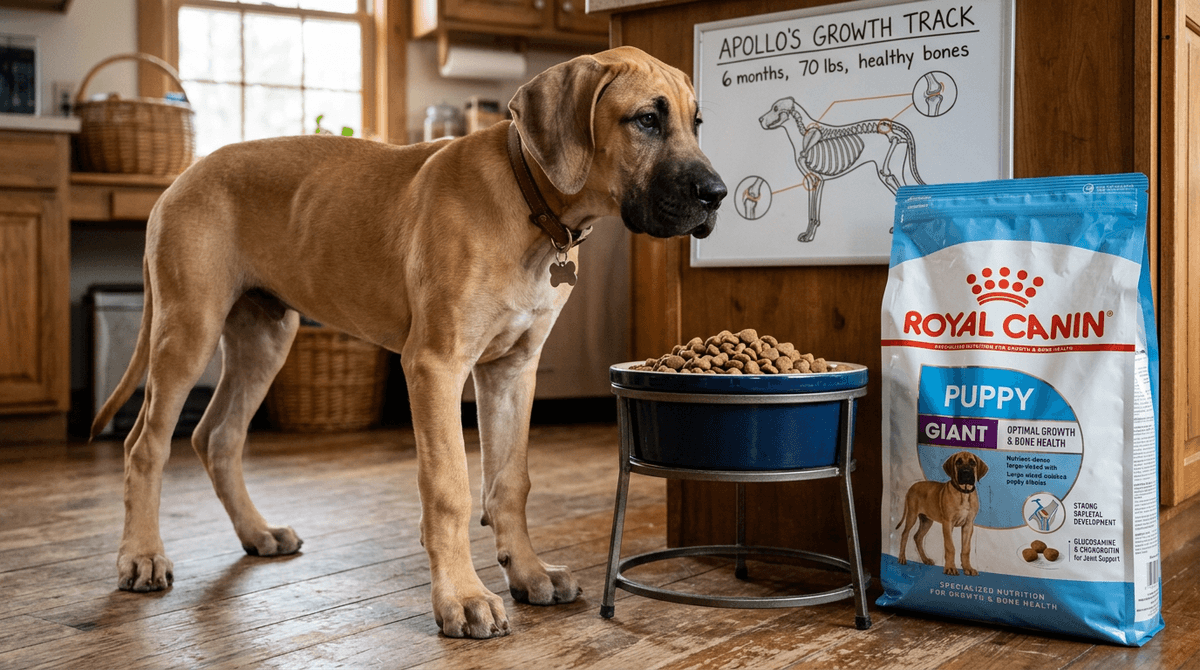
However, this rapid growth phase is also their most vulnerable period. The nutritional choices you make during their first year will permanently dictate the health of their skeletal system. Feeding a large breed puppy is fundamentally different from feeding a small or medium breed, and the most critical distinction lies in the precise balance of minerals, specifically calcium and phosphorus.
In this guide, we'll explore why large breed puppy food is essential, the dangers of improper mineral ratios, and how to choose the right diet for your growing giant.
The Unique Needs of Large Breed Puppies
Large and giant breed puppies (those expected to weigh over 50 lbs as adults) have a genetic propensity for rapid skeletal growth. While a small breed dog might reach its adult weight in 9-10 months, a giant breed may continue growing until they are 18-24 months old.
This prolonged, rapid growth window makes them highly susceptible to Developmental Orthopedic Diseases (DOD), a group of conditions that affect the bones and joints, including:
- Hip Dysplasia: Abnormal development of the hip joint leading to arthritis and lameness.
- Osteochondrosis Dissecans (OCD): Abnormal cartilage development that can cause painful joint fragments.
- Panosteitis: Painful inflammation of the outer surface of the long bones.
While genetics play a role in DOD, nutrition is the most significant environmental factor that you can control.
The Danger of "Over-Nutrition"
The biggest misconception in puppy feeding is that "more is better." For large breeds, the opposite is true. Over-nutrition—specifically, excessive caloric intake and excessive calcium—is the primary dietary cause of DOD.
1. Caloric Density and Growth Rate
If a large breed puppy consumes too many calories, they grow too fast. Their bones lengthen rapidly, but the structural density and the supporting muscles and tendons cannot keep up. This rapid growth places immense mechanical stress on the immature skeleton, leading to malformations.
Large breed puppy foods are formulated with a slightly lower caloric density and lower fat content than regular puppy foods to promote a slow, steady, and controlled growth rate.
2. The Critical Role of Calcium
Unlike adult dogs, puppies under 6 months of age cannot regulate how much calcium they absorb from their intestines; they passively absorb almost all the calcium they consume.
If you feed a diet too high in calcium, the puppy absorbs it all, leading to hypercalcemia (excess calcium in the blood). This disrupts the delicate process of endochondral ossification (how cartilage turns into bone), resulting in thickened, abnormal cartilage and bone deformities like OCD.
The Calcium to Phosphorus Ratio
Calcium doesn't act alone; it works in a delicate balance with phosphorus to build healthy bones. The absolute amount of these minerals is crucial, but the ratio between them is equally important.
The Ideal Ratio
For large breed puppies, the ideal Calcium:Phosphorus (Ca:P) ratio is strictly defined:
- Minimum: 1:1 (Equal parts calcium and phosphorus)
- Maximum: 1.5:1 (1.5 parts calcium to 1 part phosphorus)
- Ideal Target: Around 1.2:1
Absolute Calcium Limits
The absolute amount of calcium in the diet must also be strictly controlled. The Association of American Feed Control Officials (AAFCO) mandates that diets formulated for the growth of large breed dogs must contain:
- Minimum Calcium: 1.2% on a dry matter basis.
- Maximum Calcium: 1.8% on a dry matter basis.
Note: Regular puppy foods often contain calcium levels well over 2.0%, which is safe for a Chihuahua but disastrous for a Great Dane.
Large Breed Puppy Food vs. Regular Puppy Food: The Breakdown
Here is a summary of how large breed formulas differ from standard "All Life Stages" or regular puppy formulas:
| Feature | Regular Puppy Food | Large Breed Puppy Food |
|---|---|---|
| Calories/Fat | Higher (to support rapid metabolism of small dogs) | Lower (to control growth rate and prevent obesity) |
| Calcium (Max) | Often > 2.0% | Strictly capped at 1.8% (ideally 1.2% - 1.5%) |
| Ca:P Ratio | Wider acceptable range | Tightly controlled (1.1:1 to 1.5:1) |
| Joint Support | Rarely included | Often includes Glucosamine and Chondroitin |
The Danger of Supplementation
Because large breed puppy foods are already perfectly balanced, you must never add calcium supplements (like bone meal or calcium pills) to their diet. Adding calcium disrupts the carefully formulated Ca:P ratio and pushes the absolute calcium levels into the danger zone, virtually guaranteeing skeletal abnormalities.
Similarly, avoid adding large amounts of high-phosphorus foods (like excessive muscle meat) as this can invert the ratio, leading to nutritional secondary hyperparathyroidism, where the body pulls calcium out of the bones to balance the blood, resulting in weak, brittle bones.
Choosing the Right Food
When selecting a food for your large breed puppy, look for the following:
- The AAFCO Statement: Ensure the bag explicitly states it is formulated for the growth of large size dogs (70 lbs or more as an adult).
- Guaranteed Analysis: Check the calcium and phosphorus levels to ensure they fall within the safe ranges discussed above.
- Veterinary Approval: Brands that conduct extensive feeding trials and employ board-certified veterinary nutritionists (like Purina Pro Plan, Hill's Science Diet, and Royal Canin) are generally the safest choices for large breeds.
Conclusion
Feeding a large breed puppy requires precision and restraint. By choosing a specifically formulated large breed puppy food with tightly controlled calcium and phosphorus ratios, and by keeping your puppy lean to promote slow growth, you provide the foundation for a strong, healthy skeleton that will support them for a lifetime.


