
You've seen it on every bag and can: a feeding chart that tells you how many cups or grams to feed based on your pet's weight. It looks so helpful—until you realize your dog is gaining weight on the "recommended" amount, or your cat is always hungry. What's going on?
The truth is that feeding guidelines on pet food bags are notoriously unreliable. They're designed for a hypothetical average pet that doesn't exist. Your pet's actual needs depend on their age, activity level, metabolism, body condition, and whether they're spayed or neutered—none of which those charts account for. This article explains why bag guidelines often miss the mark and how to feed your pet the right amount instead.
Why Feeding Guidelines on Pet Food Bags Are Misleading
1. They're Based on "Average" Energy Needs
Pet food companies typically base their feeding charts on average maintenance energy requirements (MER) for a given weight range. But "average" hides huge variation:
- A sedentary, spayed adult dog may need 20–30% fewer calories than an intact, active dog of the same weight.
- A senior cat often needs fewer calories than a young adult cat of the same weight.
- Breed and body type matter: a lean Greyhound and a stocky Bulldog at the same weight have different needs.
The bag can't know if your pet is a couch potato or an athlete, so it guesses somewhere in the middle. That guess is wrong for many pets.
2. Weight Ranges Are Too Broad
Charts usually group pets into wide weight bands (e.g., "10–25 lbs," "26–50 lbs"). A 10-pound dog and a 25-pound dog have very different calorie needs, but the bag gives them the same portion. That means:
- Smaller pets in the range are often overfed (leading to weight gain).
- Larger pets in the range may be underfed (leading to hunger or weight loss).
So even when the formula is reasonable, the application is imprecise.
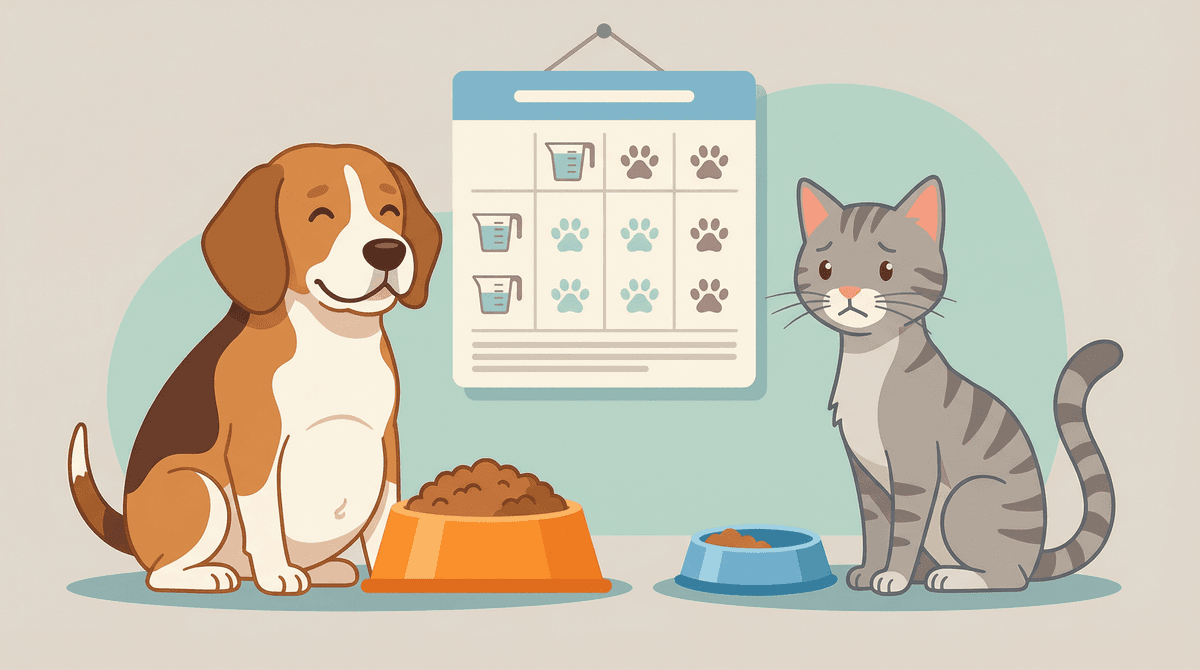
3. They Ignore Life Stage and Body Condition
Feeding guidelines rarely distinguish between:
- Puppies and kittens (who need more calories for growth)
- Adults (maintenance)
- Seniors (who often need fewer calories)
- Overweight or underweight pets (who need adjusted portions)
Many bags show a single chart for "adult maintenance." If you have a growing puppy or an overweight senior, that chart doesn't apply—yet it's the one most people use.
4. They Don't Account for Spaying and Neutering
Spayed and neutered pets typically have lower energy needs (often 20–30% less) and sometimes an increased appetite. Feeding them the same amount as an intact pet of the same weight is a common cause of obesity. Bag guidelines rarely mention spay/neuter status, so they contribute to overfeeding in sterilized pets.
5. Calories Per Cup Vary by Formula and Batch
The feeding chart assumes you're feeding exactly the product in the bag at the stated calorie density. But:
- Calorie content can vary by formula, flavor, and batch.
- If you switch to a different flavor or a "light" version, the chart is wrong.
- Measuring matters: a heaped cup vs. a level cup changes how much you're actually feeding.
So even when you follow the chart, you may be over- or underfeeding.
What Happens When You Follow Bag Guidelines?
- Overfeeding: Very common, especially in spayed/neutered or low-activity pets. Result: weight gain, obesity, and related health risks.
- Underfeeding: Can happen in active, intact, or high-metabolism pets. Result: hunger, weight loss, low energy, or poor condition.
- Confusion: When the chart doesn't match your pet's reality, you're left guessing—and many owners give extra "a little more" or "a little less" without a clear target.
The only way to get it right is to calculate your pet's actual calorie needs and then convert that into portions for the specific food you're feeding.
How to Feed Your Pet the Right Amount
Step 1: Calculate Your Pet's Daily Calorie Needs (MER)
Your pet's Maintenance Energy Requirement (MER) is the number of calories they need per day to maintain a healthy weight. It depends on:
- Weight (and whether they need to lose, maintain, or gain)
- Life stage (puppy/kitten, adult, senior)
- Activity level
- Spay/neuter status
- Body condition (ideal, overweight, underweight)
Veterinary nutrition uses formulas (such as RER × life-stage and activity factors) to estimate MER. Our pet nutrition calculator does this for you: you enter your pet's details, and it gives you a daily calorie target.
Step 2: Find the Calorie Content of Your Pet's Food
Look for the calorie statement on the bag or can—usually expressed as kcal per cup, per kilogram, or per 100 g. If it's not on the package, check the manufacturer's website. Without this number, you cannot convert calories into portions. For more on this, see our article The Calorie Statement: Your Key to Accurate Portioning.
Step 3: Divide Daily Calories by Calories Per Serving
- Daily calories (MER) ÷ calories per cup (or per 100 g) = how many cups (or 100 g) per day.
- Split that into the number of meals you feed (e.g., 2 for dogs, 2–3 for cats).
Example: Your dog needs 600 kcal/day. The food has 300 kcal per cup.
600 ÷ 300 = 2 cups per day (e.g., 1 cup per meal if you feed twice daily).
This gives you a personalized portion instead of a generic chart.
Step 4: Monitor and Adjust
Use body condition score (BCS) and weight to check that your pet is maintaining a healthy condition. If they're gaining weight, reduce the portion slightly; if they're losing or always hungry, increase it. Recalculate if their weight, activity, or life stage changes.
The Bottom Line
Feeding guidelines on pet food bags are a convenient starting point, but they're not designed for your individual pet. They ignore life stage, activity, spay/neuter status, and body condition, and they use broad weight ranges that don't match real calorie needs.
For accurate, personalized portions:
- Calculate your pet's MER using a pet nutrition calculator.
- Use the calorie statement on the food to convert MER into cups or grams per day.
- Measure portions consistently and adjust based on body condition and weight.
Once you know your pet's target calories and the calories in their food, you can ignore the bag chart and feed with confidence.
Ready to get a precise portion for your pet? Use our free pet meal planner to calculate your pet's daily calorie needs and recommended portions based on their weight, age, activity, and goals—not a one-size-fits-all chart.


