
Key takeaways
- The failure mode is not “different foods”—it is unmeasured access and cross-meal scavenging.
- Separation + measurement beats “everyone eats when hungry” in almost every multi-dog scenario.
- Calorie needs differ by size, age, neuter status, activity, and body condition—treat each dog as its own case.
- If one dog needs weight loss, the household routine must make the lean plan the default, not an occasional hope.
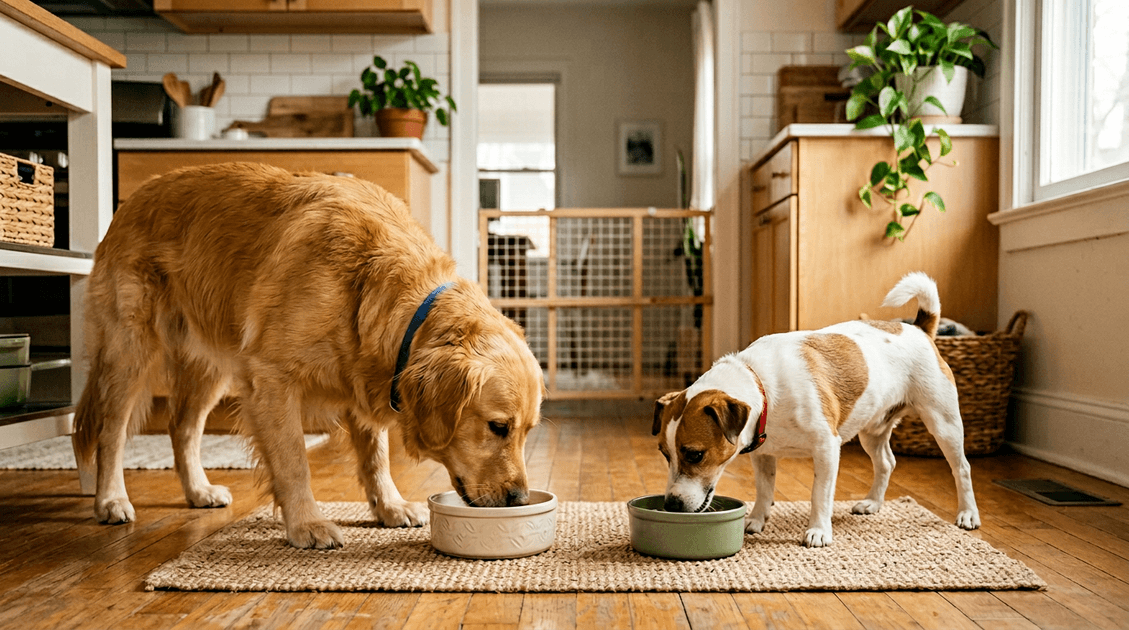
Multi-dog homes are joyful—and nutritionally messy. One dog may need weight loss, another growth, another maintenance. Add a toddler dropping snacks, a roommate feeding “just a little,” and a clever counter-surfer, and you get the most common outcome: the overweight dog stays overweight while everyone believes they are “hardly eating.”
This guide is about systems: how to run one kitchen without accidentally running a buffet.
Name the goal for each dog (one sentence each)
Before tactics, write down:
- Dog A: target = maintenance / muscle / sport / etc.
- Dog B: target = weight loss / GI stability / etc.
- Dog C: puppy / senior / medical diet / etc.
If you do not have calorie targets, start with body condition—not just weight:
The non-negotiable: measured meals beat free feeding (for most households)
Free feeding can work for some single-pet homes. In multi-dog homes, it often becomes resource competition and calorie ambiguity.
Measured meals let you answer: “How many kcal did this dog actually ingest today?”
For calorie fundamentals:
Separation tactics (from mild to strict)
Level 1: Different bowls, different rooms, timed pickup
- Feed in separate spaces
- Pick up uneaten food after 10–20 minutes (adjust with vet guidance for medical cases)
- This alone prevents “slow eater subsidizes fast eater”
Level 2: Crate / pen / baby gate feeding
Useful when:
- One dog finishes instantly and visits others
- You have a history of food aggression or anxiety
Level 3: Different feeding schedules
Sometimes staggering meals by 30–60 minutes reduces stealing pressure—especially if you can supervise.
The “weight loss dog” problem: protect the diet from the household
Weight loss fails in multi-dog homes for predictable reasons:
- Extra licks from another dog’s bowl
- Children feeding the “sad eyes” dog
- Treat training focused on the easier dog
A useful rule: the dog on a weight plan eats in the most controlled environment—often first, separately, and with the fewest humans moving through the space.
For weight-loss nutrition concepts:
Puppies vs adults: don’t let growth calories become the household default
Puppies often need more calorie density per pound than adults. That does not mean every adult dog should eat “puppy food extras.”
If you have a puppy and adults, keep puppy portions clearly labeled and stored separately when possible.
Treats and training in multi-dog homes (the hidden multiplier)
Training treats are where “I barely fed him” breaks down:
- Treats given to one dog may be noticed by others, creating stress
- Some owners double treats to “be fair”
A better approach:
- Train individually when possible
- Budget treat calories per dog using the same ledger mindset as meals
Read:
When food stealing is not “naughty”—it’s a safety issue
If dogs fight over food, or if there is guarding, do not rely on advice articles. Seek a qualified trainer or veterinary behaviorist. Management (gates, separation) is still nutrition because it determines who actually eats what.
FAQ
Should I feed different brands in one home?
Often yes—different dogs have different needs. The key is consistency within each dog unless your veterinarian recommends a transition.
Is automatic feeder fair?
Automatic feeders can help timed meals, but they can also enable the wrong dog to access the wrong calories if not physically separated.
Can PetMealPlanner help each dog separately?
Yes—think of each pet as its own plan, even if you live in one kitchen.
Conclusion
Multi-dog feeding is logistics + nutrition. Measure, separate, pick up bowls, and protect the weight-loss plan like it is a medical protocol—because for many dogs, it is.
Disclaimer: Educational content only. For food aggression, sudden appetite changes, vomiting, or weight loss you did not intend, contact your veterinarian.


