
Key takeaways
- Mixing foods is fine—double counting calories is the problem. One dog should have one daily calorie budget, then you allocate it across formats.
- Labels may report calories as kcal/kg, kcal per can, or kcal per cup—you must convert to a common basis before adding.
- Treats, toppers, dental chews, and “just a spoon” of peanut butter still count toward the same budget.
- If your dog needs weight loss, the budget tightens first—see our weight management resources linked below.
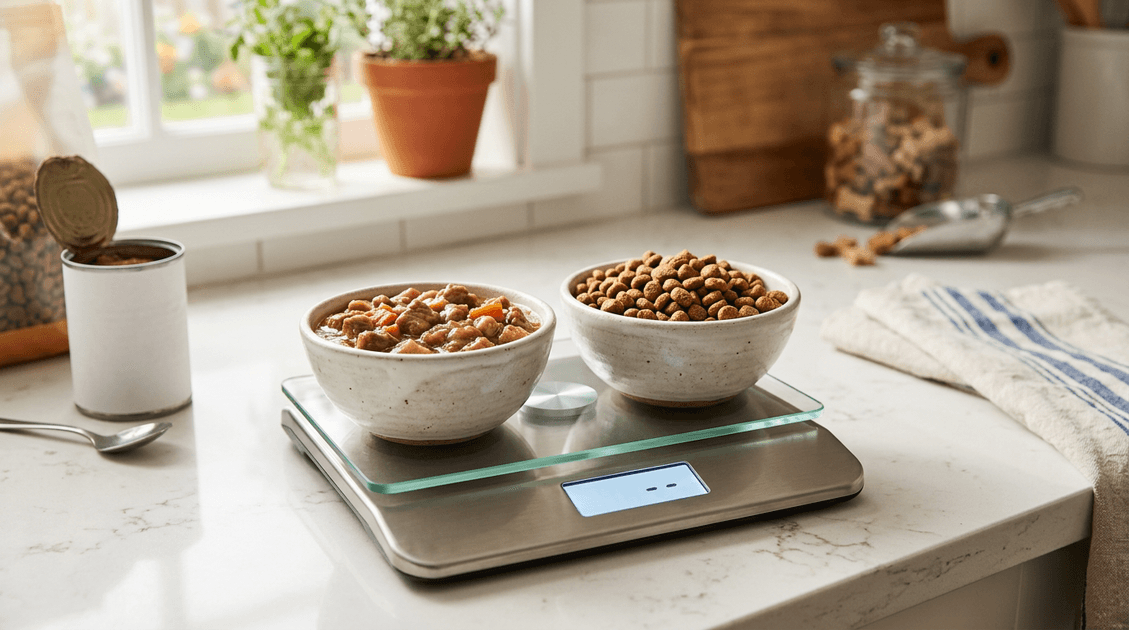
Dog owners mix wet and dry for excellent reasons: palatability, hydration, variety, and practicality. But from a nutrition math perspective, mixing introduces one dominant failure mode: the diet becomes two diets. You mentally feed “some kibble” plus “some canned,” while the dog’s metabolism tracks one total energy intake.
This guide gives you a repeatable method to calculate calories when mixing wet and dry dog food—without requiring brand loyalty and without pretending there is a single universal number for every dog.
Step 0: Start with a daily calorie target (maintenance or weight plan)
Before you allocate across wet and dry, you need a target for the day. That target depends on:
- Body size and muscle mass
- Neuter status and age
- Activity level
- Whether you want maintenance or weight loss
If you are new to calorie budgeting, read these first:
- RER explained: your pet’s basic calorie needs
- MER explained: calculating your pet’s true daily energy needs
- The calorie statement: your key to accurate portioning
Step 1: Find the calorie density for each food (same units)
Dry food: kcal per gram is your friend
Many labels provide Metabolizable Energy (ME) as:
- kcal/kg, or
- kcal per cup (less precise unless you know the cup’s grams)
If you have kcal/kg, convert your portion to grams:
- kcal in portion = (grams fed ÷ 1000) × (kcal per kg)
If you only have kcal/cup, weigh your scoop once on a kitchen scale. Cup volume is not standardized across kibble shapes.
Wet food: use kcal per can or kcal per kilogram
Canned foods often print kcal per can (for the standard can size). If the label lists kcal/kg, use grams the same way as dry.
Step 2: Decide the split (50/50 is not a nutrient strategy)
There is nothing magical about “half wet, half dry.” What matters is:
- Calories sum to your target
- Your dog tolerates the diet (stool quality, appetite, medical needs)
Some dogs do best with a small wet “topper” calorie-wise and most calories from dry for dental and cost reasons. Others need more wet for hydration or palatability.
Step 3: Work one worked example (the heart of skyscraper utility)
Assume:
- Daily target: 900 kcal/day (example only—your dog may differ)
- Dry food: 3,600 kcal/kg
- Wet food: 400 kcal per 13.2 oz can
You want 600 kcal from dry and 300 kcal from wet today.
Dry grams for 600 kcal:
- kcal/kg = 3,600 → 3.6 kcal/g
- grams = 600 ÷ 3.6 = 167 g dry
Wet cans for 300 kcal:
- 300 ÷ 400 = 0.75 of a can (measure by weight on a kitchen scale if you want precision)
Now verify: 600 + 300 = 900 kcal.
This is the core skill: convert each component to kcal, then add.
Where mixing goes wrong: the “bag chart + can guess” method
Bag feeding charts are population estimates. Canned labels may show “feeding guide” ranges. If you apply both without reconciling to one calorie target, you can drift hundreds of kcal per week—enough to drive weight gain in indoor dogs.
If weight trends matter to you, also read:
Treats and toppers: the silent calorie leak
If you mix wet and dry correctly but add:
- Training treats
- Dental chews
- Table scraps
- Oil supplements “for coat”
…you may still overfeed. A simple rule: decide treat calories first (often 5–10% of daily calories, depending on your plan), then allocate the remainder to meals.
For treat budgeting:
Medical and practical caveats
- Pancreatitis history, GI disease, or food-responsive chronic disease: mixing may not be appropriate even if the math is perfect—follow your veterinarian.
- Consistency: frequent rotation without a system increases the chance you lose track of densities.
FAQ
Is wet food “more fattening” than dry?
Not inherently. Calories determine weight trends, not the presence of moisture. Wet food is less calorie-dense per gram because water adds weight without adding energy.
Should I mix foods for every meal?
Some dogs do better with consistency; others tolerate variety. The math method works either way—just keep daily calories aligned with your target across meals.
Can PetMealPlanner help?
Yes—our app is built to help you translate body condition and goals into practical portion thinking. Use it alongside your veterinarian’s medical guidance.
Conclusion
Mixing wet and dry is a smart strategy for many households—if you reconcile everything to one calorie budget. Learn your kcal/kg (or can totals), weigh portions when possible, and treat treats as part of the same ledger.
Medical disclaimer: Educational information only; not a substitute for veterinary advice. Seek professional guidance for medical conditions, therapeutic diets, or if your dog is a puppy, pregnant, or lactating.


