
Puppies grow fast—and their nutritional needs are different from adult dogs. How much and how often you feed a puppy depend on age, size, breed, and the food you use. Get it right and you support healthy growth; get it wrong and you risk underfeeding, overfeeding, or growth problems (especially in large breeds).
This guide covers puppy feeding by age, size, and breed: meal frequency, how to calculate how much to feed using MER and the calorie statement, and how to use our pet calorie calculator so your puppy gets the right portions from weaning through adulthood.
Why Puppy Feeding Is Different
Puppies need:
- More calories per pound than adults (growth requires extra energy).
- Higher protein and certain minerals (e.g., calcium, phosphorus) in the right balance for bone and tissue development.
- Frequent meals when very young (small stomachs, high needs).
- Controlled growth in large breeds—too many calories can drive growth too fast and increase the risk of orthopedic issues.
So "puppy feeding" isn't just "feed more." It's the right amount, the right food (AAFCO growth formula), and the right schedule.
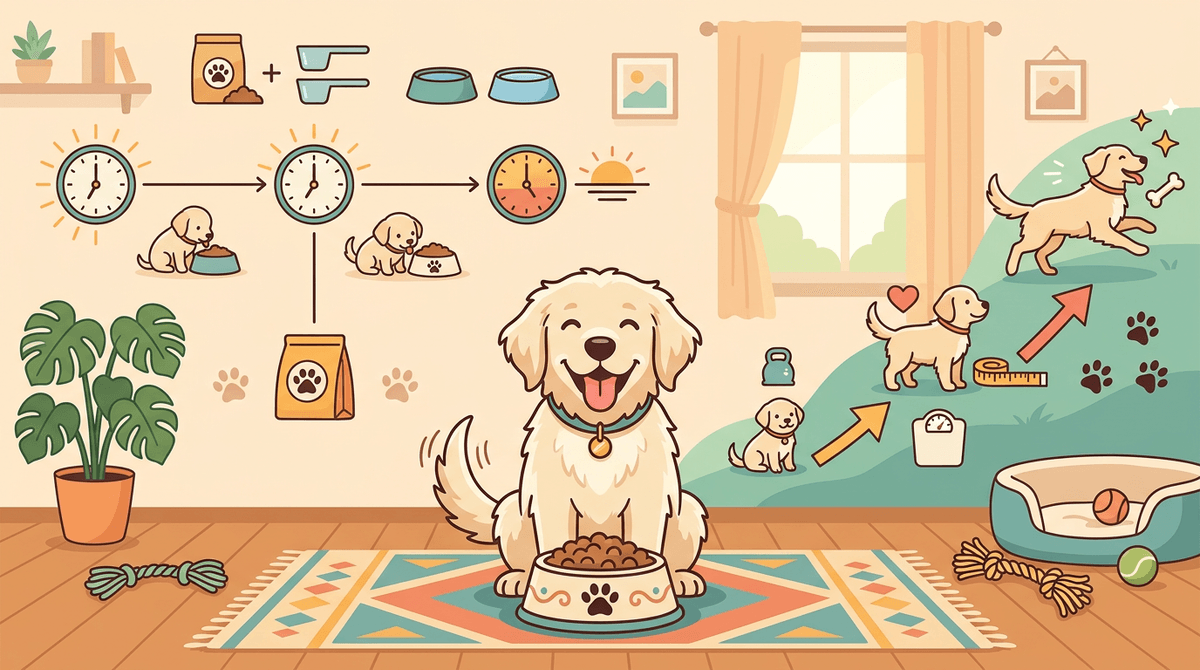
How Often to Feed a Puppy
- Weaning to ~4 months: 3–4 meals per day. Small stomachs and high energy needs make frequent meals easier to digest and more stable for blood sugar.
- 4–6 months: 3 meals per day is common; some owners drop to 2 by 6 months.
- 6–12 months: 2–3 meals per day. Large-breed puppies may stay on 3 meals longer to spread calories.
- After 12 months (or when adult weight/condition is reached): Transition to adult food and typically 2 meals per day. See Why You Shouldn't Switch Your Pet's Food Suddenly for a gradual change.
Small breeds mature faster (adult by ~9–12 months); large and giant breeds can need growth-formula food and adjusted portions until 18–24 months.
How Much to Feed: Use MER, Not Just the Bag
Bag feeding guidelines for puppies are often too high or too generic. The right amount depends on:
- Current weight and target adult weight (for large breeds, we want steady growth, not maximum speed).
- Age (growth factors change over time).
- Activity level and body condition (BCS).
Steps:
- Use our pet calorie calculator: select "dog," life stage "puppy," enter current weight and (if known) target adult weight/breed size. Get the daily calorie (MER) for growth.
- Find the calorie statement on the puppy food (kcal per cup or per 100 g).
- Daily amount = MER ÷ kcal per cup (or per 100 g). Split that into 3–4 meals (young) or 2–3 (older puppy).
Example: Puppy needs 600 kcal/day; food has 400 kcal/cup → 1.5 cups per day. If feeding 3 times: 0.5 cup per meal.
Puppy Feeding by Size and Breed
Small-Breed Puppies
- Reach adult size quickly (often by 9–12 months).
- Need a small-breed puppy formula or a growth formula with smaller kibble.
- Higher metabolic rate: more kcal per pound than large breeds. Feed nutrient-dense food in small, frequent meals.
Medium-Breed Puppies
- Typically adult by 12–15 months.
- Use a standard AAFCO growth formula and portion by MER. Monitor body condition—puppies should be lean, not chubby.
Large- and Giant-Breed Puppies
- Slower maturation (18–24 months or more).
- Critical: Avoid overfeeding. Excess calories drive rapid growth and can increase the risk of developmental orthopedic disease. Use a large-breed puppy formula (controlled calcium and calories) and portion by MER; keep the puppy at a lean body condition, not roly-poly.
- Stay on growth formula until the vet says to switch to adult; then transition gradually.
What to Feed: AAFCO Growth Formula
Choose a diet that meets AAFCO for growth (or "all life stages"). Don't feed adult maintenance or "all life stages" without a growth claim unless your vet advises it. Puppy formulas are formulated for higher protein, fat, and key minerals.
When to Switch to Adult Food
- Small breeds: Often around 9–12 months.
- Medium breeds: Around 12–15 months.
- Large/giant breeds: Often 18–24 months, when growth plates close and the vet confirms.
Switch gradually over 7–10 days to avoid GI upset.
Common Mistakes
- Overfeeding: "Growing puppy" doesn't mean "feed as much as they want." Use MER and the calorie statement; monitor BCS.
- Underfeeding: Very active or fast-growing puppies may need more; if they're thin or hungry, recalculate MER and check the calorie density of the food.
- Feeding adult food too early: Puppies need growth formulas until they're mature.
- Ignoring treats: Keep treats within the 10% rule so they don't unbalance the diet or add excess calories.
The Bottom Line
Puppy feeding should be based on age, size, and breed: frequent meals when young, the right total amount from MER and the calorie statement, and for large breeds especially—controlled growth with a lean body condition. Use an AAFCO growth formula and transition to adult food when the puppy is mature.
For exact daily calories and portion guidance for your puppy, use our pet meal planner. It accounts for life stage, breed size, and activity so you can feed with confidence.


