
"You want to see a named protein first"—advice you've probably heard when choosing pet food. And it's partly true: the first ingredient tells you what predominates by weight in the formula as it goes into the bag or can. But "first ingredient" is only one piece of the picture. Ingredient order, quality, and the rest of the list all matter for understanding what you're really feeding.
This article explains how pet food ingredient lists work, what the first ingredient really means, and how to use the full list (along with the AAFCO statement and calorie statement) to make better choices.
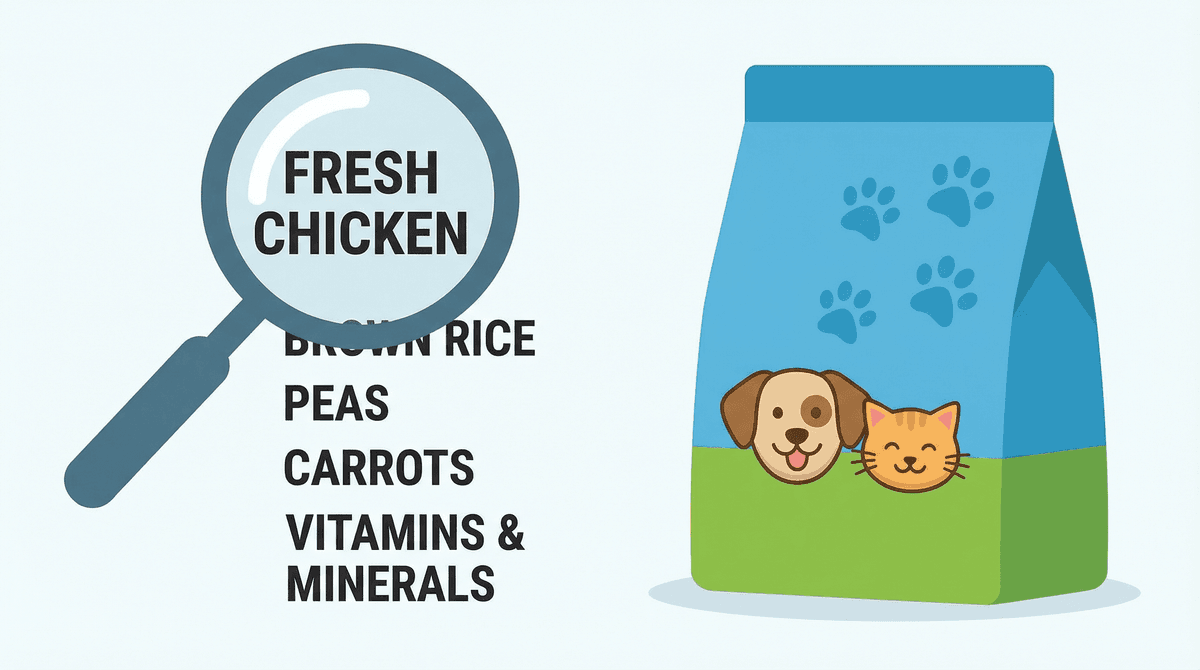
How Pet Food Ingredient Lists Work
In the US, AAFCO regulations require pet food ingredient lists to be in descending order of predominance by weight—heaviest first—based on the formula as formulated. So:
- First ingredient = the single heaviest ingredient (by weight) in the formula.
- Second = next heaviest, and so on.
Important: listing is by weight in the formula (as formulated), not by volume. Ingredients with high moisture (e.g., fresh chicken) weigh more per unit than drier ingredients (e.g., chicken meal), so "chicken" can appear first even if, after processing, there is less chicken protein per cup than a concentrated ingredient like "chicken meal" that appears later. That's why "first" is useful but not the only thing to look at.
What "First Ingredient" Really Means
When the First Ingredient Is a Named Protein
- "Chicken," "deboned chicken," "lamb," "salmon," "beef" (or similar): The formula is built around that animal protein as the primary ingredient by weight. That's generally a good sign—you're seeing a specific, identifiable source first.
- "Chicken meal," "lamb meal," "fish meal": Concentrated forms of the same protein (more protein per ounce because moisture is removed). So "chicken meal" as first ingredient can actually deliver more protein per cup than "chicken" first, depending on the rest of the formula.
So "first ingredient" tells you what leads the list by weight, not the exact amount of protein or the full nutritional value. Quality and digestibility matter too—see our article on why protein quality matters.
When the First Ingredient Is a Grain or Other Carbohydrate
- "Corn," "wheat," "rice," "brewers rice" first: The formula may be built around a grain or starch as the heaviest ingredient. That doesn't automatically make it "bad"—some pets do fine on grain-inclusive diets—but it means the primary ingredient by weight is not a protein. If you prefer a protein-first diet, look for a formula where a named meat or meat meal is first.
When the First Ingredient Is Vague
- "Meat meal," "poultry by-products," "animal by-products": These are legal terms but vague—you don't know the exact source or quality. Many owners and vets prefer specific names (e.g., "chicken meal," "lamb") so you know what you're feeding.
So: first ingredient = heaviest ingredient by weight. A named animal protein first is often a good sign; vague or grain-first lists may still be adequate but are worth reading further.
Reading the Rest of the List
- Look at the first several ingredients: They make up most of the product. The first 3–5 give you a clear picture of the main components (proteins, grains, fats).
- Watch for splitting: Sometimes similar ingredients are listed separately (e.g., "corn," "corn gluten meal," "corn flour") so each appears lower on the list. Combined, they might outweigh the first ingredient. So scan the whole list for repeated or similar items.
- Fats and oils: Often appear in the first half of the list. Named sources (e.g., "chicken fat") are usually preferable to generic "animal fat" if you're comparing quality.
- Additives and vitamins: Usually at the end. They're required for a complete and balanced diet; the long list of vitamins and minerals doesn't mean the food is "chemical-heavy"—it means it's fortified to meet nutrient standards.
What to Look For (Quick Checklist)
- Named protein in the first few ingredients (e.g., chicken, lamb, salmon, or chicken meal, lamb meal).
- Specific animal fats (e.g., chicken fat) when possible.
- Consistency with the front-of-pack claims (e.g., "chicken recipe" should have chicken prominent in the list).
- Complete and balanced per the AAFCO statement.
- Calorie statement so you can portion correctly and avoid overfeeding.
What "First Ingredient" Doesn't Tell You
- Exact protein percentage (see Guaranteed Analysis and the calorie statement).
- Digestibility or bioavailability (quality of the protein and processing).
- Whether the food is complete and balanced (see AAFCO).
- How much to feed (use MER and the calorie statement).
So use the ingredient list together with the AAFCO statement, guaranteed analysis, and calorie content—not in isolation.
The Bottom Line
The first ingredient on a pet food label is the heaviest ingredient by weight in the formula. A named animal protein (e.g., chicken, chicken meal, lamb, salmon) first is generally a good sign; vague terms or grains first may still be adequate but are worth a closer look. Read the first several ingredients and scan for splitting; then check the AAFCO statement for completeness and the calorie statement for portioning.
Once you've chosen a food, use our pet meal planner to get your pet's daily calorie need and the right portion size—so the good ingredients you see on the label are fed in the right amount.


