
Should you feed wet cat food, dry cat food, or both? The answer depends on your cat's health, preferences, and your routine—and no matter which you choose, portions must be right to avoid obesity or underfeeding.
This guide compares wet vs. dry cat food, explains when mixed feeding (combining both) makes sense, and shows how to set portions using your cat's MER and the calorie statement—with help from our pet calorie calculator.
Wet vs. Dry Cat Food: Quick Comparison
| Aspect | Wet (canned, pouches) | Dry (kibble) |
|---|---|---|
| Moisture | High (~75–80%) | Low (~6–10%) |
| Calories | Often lower per gram; check label | Often higher per cup/gram |
| Palatability | Many cats prefer it | Convenient; some cats prefer it |
| Dental | No proven cleaning effect | No proven cleaning effect by itself |
| Storage | Refrigerate after opening | Room temp, easy to measure |
| Cost | Often more per calorie | Often less per calorie |
Both can be AAFCO complete and balanced. The "best" choice is the one that fits your cat's needs and that you can portion correctly.
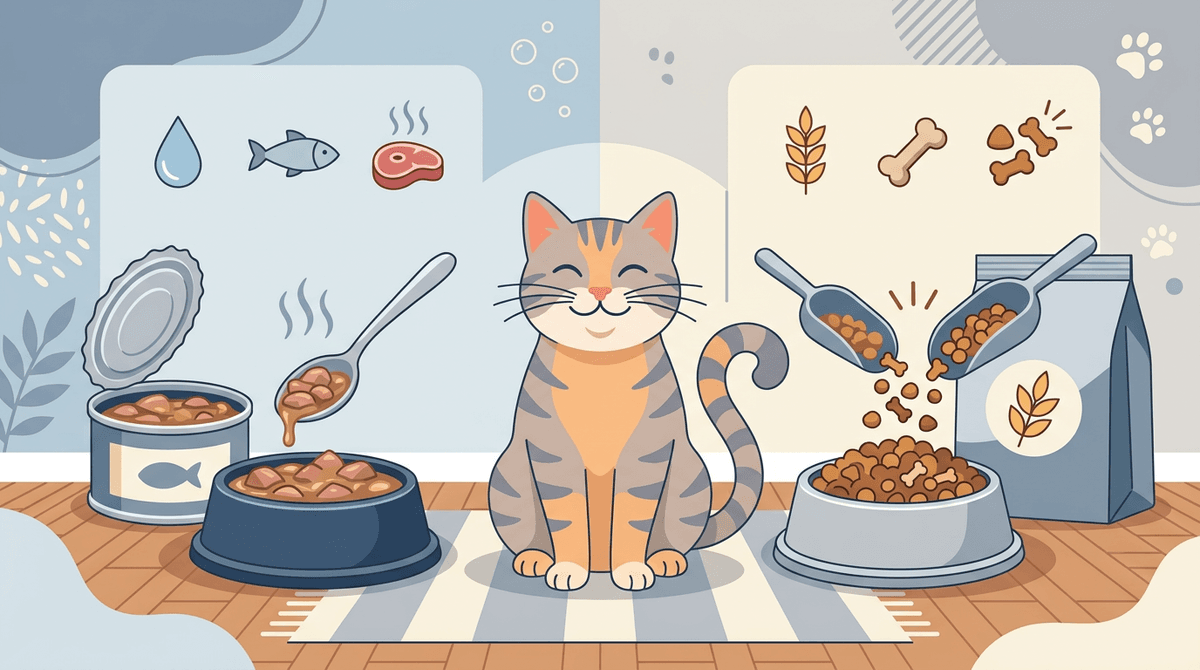
Benefits of Wet Cat Food
- Hydration: High moisture content helps support fluid intake. Useful for cats who don't drink much or who have a history of urinary or kidney concerns (always discuss diet with your vet for medical conditions).
- Palatability: Many cats find wet food more appealing—helpful for picky eaters or senior cats with reduced appetite.
- Lower calorie density (often): Per gram, wet food is often less calorie-dense, so a larger volume can fill the bowl for fewer calories—useful for weight management when portions are still calculated by MER.
Wet food is not "better" across the board; it's a tool. Portion control still matters—see The Problem with Feeding Guidelines on Pet Food Bags.
Benefits of Dry Cat Food
- Convenience: No refrigeration; easy to leave out for grazing (if your cat doesn't overeat) or to measure meals.
- Cost: Often cheaper per calorie; useful when feeding multiple cats or on a budget.
- Storage: Long shelf life when sealed.
Dry food is not "bad." When complete and balanced and portioned by calories, it can support a healthy cat. The myth that dry food "cleans teeth" is not well supported—dental health still needs appropriate care (chews, brushing, or vet cleanings as advised).
Mixed Feeding: Combining Wet and Dry
Mixed feeding means offering both wet and dry—e.g., wet at one meal, dry at another, or both in the same day in set portions.
Advantages:
- Variety and palatability: Some cats enjoy both; can help with boredom or pickiness.
- Hydration plus convenience: Wet adds moisture; dry can be left for a meal or measured easily.
- Flexibility: You can use wet for part of the day and dry for the rest, as long as total daily calories match your cat's MER.
How to do it right:
- Get your cat's daily calorie target (MER) from our calculator.
- Read the calorie statement on both the wet and dry food (kcal per can, per pouch, or per 100 g for wet; kcal per cup or per 100 g for dry).
- Decide the split (e.g., 50% wet, 50% dry by calories). Example: MER = 200 kcal. Wet = 100 kcal/day (e.g., half a 5.5 oz can if it's 200 kcal/can); dry = 100 kcal/day (e.g., 1/4 cup if 400 kcal/cup).
- Keep treats within the 10% rule.
Don't free-feed dry and add wet on top without counting—that often leads to overfeeding.
Portioning Wet and Dry Correctly
- Wet: Use kcal per can/pouch or per 100 g. MER ÷ kcal per can = cans per day (or equivalent).
- Dry: Use kcal per cup or per 100 g. MER ÷ kcal per cup = cups per day.
- Mixed: Add the calories from wet + dry to equal MER. Weigh or measure so you're not guessing.
Monitor body condition and adjust by ~5–10% if your cat gains or loses weight.
What About "Cats Need Wet Food"?
Cats are obligate carnivores and historically get much of their water from prey. So hydration is important—and wet food can help. But many cats do fine on dry food if they drink enough and the diet is complete and balanced. The key is: (1) a complete diet, (2) adequate total water intake (food + drinking), and (3) correct calories. For cats with kidney or urinary issues, your vet may specifically recommend wet or a prescription diet.
The Bottom Line
Wet vs. dry isn't a single "best"—each has pros and cons. Mixed feeding can work well when total daily calories match your cat's MER and you use the calorie statement for both. Whatever you choose, portion by calories, not by "one can" or "a scoop," and monitor body condition.
For exact daily portions for your cat, use our pet meal planner. It uses RER, MER, and your cat's body condition and goals so you can feed wet, dry, or mixed with confidence.


