
"Human-grade" on a dog food label sounds like a guarantee of top quality—ingredients fit for your own plate, made in a kitchen, not a feed mill. But what does human-grade dog food actually mean, and is it really healthier for your dog?
The term has a specific meaning in the pet food industry and in regulation. Not every brand that uses the phrase meets the strict definition, and meeting it doesn't automatically make a diet complete, balanced, or right for every dog. This guide explains what human-grade means, how it differs from feed-grade, and how to decide if it's worth it for your pet—plus how to pair any diet with the right portions using tools like our pet calorie calculator.
What Does "Human-Grade" Actually Mean?
Human-grade (or "human edible") means that every ingredient and the entire product are produced, handled, and stored in a facility approved for manufacturing human food. The whole supply chain—from ingredient sourcing to the finished product—must meet the same standards as food intended for people.
Key points:
- Whole product, not just ingredients: For a product to be legally marketed as human-grade in the U.S., the entire product must be made in a human-food facility. A bag of kibble that uses "human-grade ingredients" but is made in a pet-food plant is not human-grade.
- Facility and handling: Processing, packaging, and storage must comply with FDA regulations for human food (e.g., current Good Manufacturing Practice).
- No feed-grade steps: If any part of the chain is only approved for animal feed, the product cannot be labeled human-grade.
So human-grade is first and foremost about where and how the food is made, not just the quality of the raw ingredients on paper.
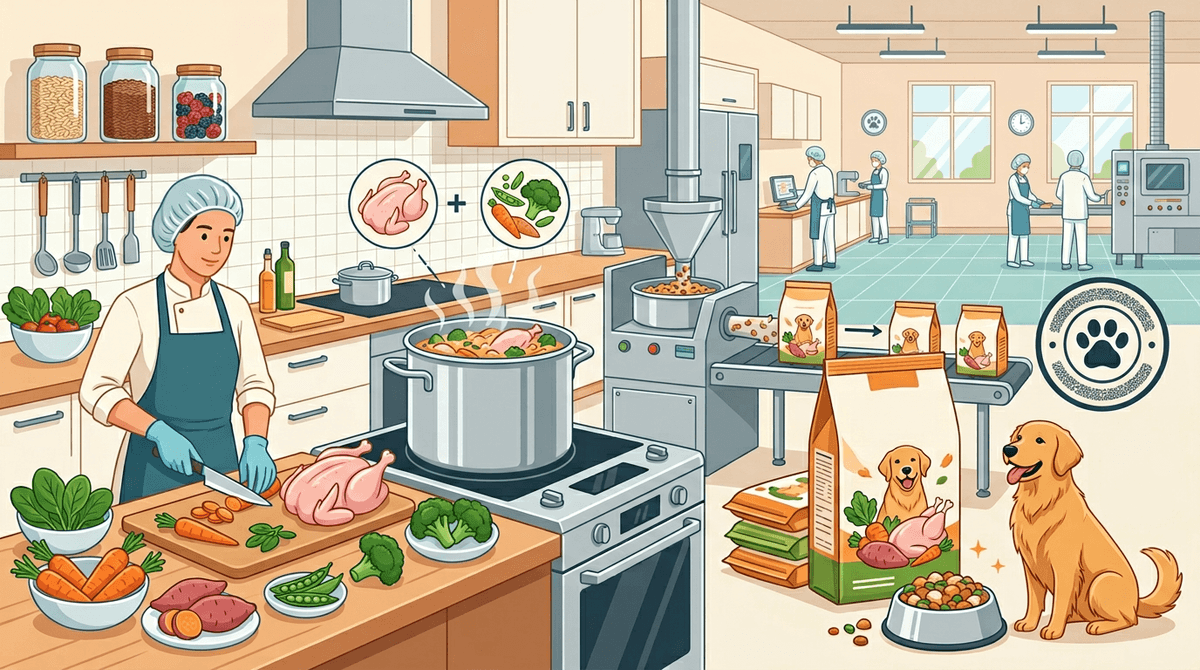
Human-Grade vs. Feed-Grade: The Real Difference
Feed-grade pet food is made in facilities and under standards approved for animal feed. Ingredients may still be safe and nutritious, but they don't have to meet the same regulatory bar as human food. By-products, certain processing methods, and sourcing that wouldn't be allowed in a human-food plant can be used.
That doesn't mean feed-grade is "bad"—most commercial dog foods are feed-grade and, when formulated to be AAFCO complete and balanced, can support a healthy dog. The difference is:
- Human-grade: Entire product made in a human-food facility; stricter handling and sourcing.
- Feed-grade: Made in an animal-feed facility; still regulated, but under feed standards.
So human-grade is a step up in facility and chain control, not necessarily a guarantee that the formula is nutritionally superior for every dog.
Is Human-Grade Dog Food Healthier?
Not automatically. "Healthier" depends on:
- Completeness and balance: The food must still meet your dog's nutritional needs. Check for an AAFCO statement (or equivalent) for the right life stage.
- Calorie density and portions: Human-grade diets can be calorie-dense. Overfeeding leads to weight gain regardless of grade—use MER and the calorie statement to set portions, and watch body condition.
- Your dog's needs: A dog with allergies, pancreatitis, or kidney disease needs a formula suited to that condition; human-grade alone doesn't fix that.
Human-grade can mean higher quality control and often fewer "mystery" ingredients in the chain. It does not replace the need for a complete, balanced diet and correct portions.
What to Look For on the Label
- "Human-grade" with a clear claim that the entire product is produced in a human-food facility (some brands spell this out on the bag or website).
- AAFCO statement for the life stage you need (e.g., adult maintenance, growth).
- Calorie statement (kcal per cup or per 100 g) so you can portion accurately.
- Ingredient list that you understand—see The Ingredient List: What the First Ingredient Really Means.
If a brand says "human-grade ingredients" but the product is made in a feed facility, it's not human-grade by the strict definition.
When Human-Grade Might Be Worth It
- You want maximum transparency and facility-level quality control.
- You're willing to pay more and verify that the product is truly human-grade and complete and balanced.
- Your dog does well on the formula and you can portion it correctly using MER and the calorie statement.
When It Might Not Matter as Much
- Your dog is already thriving on a feed-grade, AAFCO-complete diet and you're feeding the right amount.
- Budget is a constraint; many feed-grade diets are nutritionally solid when portions are right.
- Your dog needs a prescription or veterinary diet; those are usually feed-grade but medically appropriate.
The Bottom Line
Human-grade dog food means the entire product is made in a human-food facility under human-food standards—it's a real, definable standard. It can mean better oversight and often higher-quality sourcing, but it doesn't automatically make a diet healthier or complete. Whatever you choose, pair it with correct portions based on your dog's MER, use the calorie statement, and keep treats within the 10% rule.
To get exact daily portions for any food—human-grade or not—use our pet meal planner. It uses RER, MER, and your dog's body condition and goals to give you precise, vet-aligned recommendations.


